In a revelation that bridges astrophysics and climate science, researchers from the University of Washington have successfully reconstructed a 30,000-year timeline of Arctic sea-ice coverage using an unlikely source: cosmic dust. The study, published November 6 in the journal Science, provides the first continuous historical record of sea-ice shifts prior to the satellite era, offering critical insights into how the polar cap responds to global warming.
The findings challenge existing assumptions about the drivers of polar melt. According to the research, ancient ice levels fluctuated primarily in response to atmospheric warming rather than ocean heat circulation. This distinction is vital for scientists and policymakers attempting to forecast the timeline for a potentially ice-free Arctic, a scenario with profound implications for global trade, geopolitics, and coastal ecosystems.
The Helium-3 Time Capsule
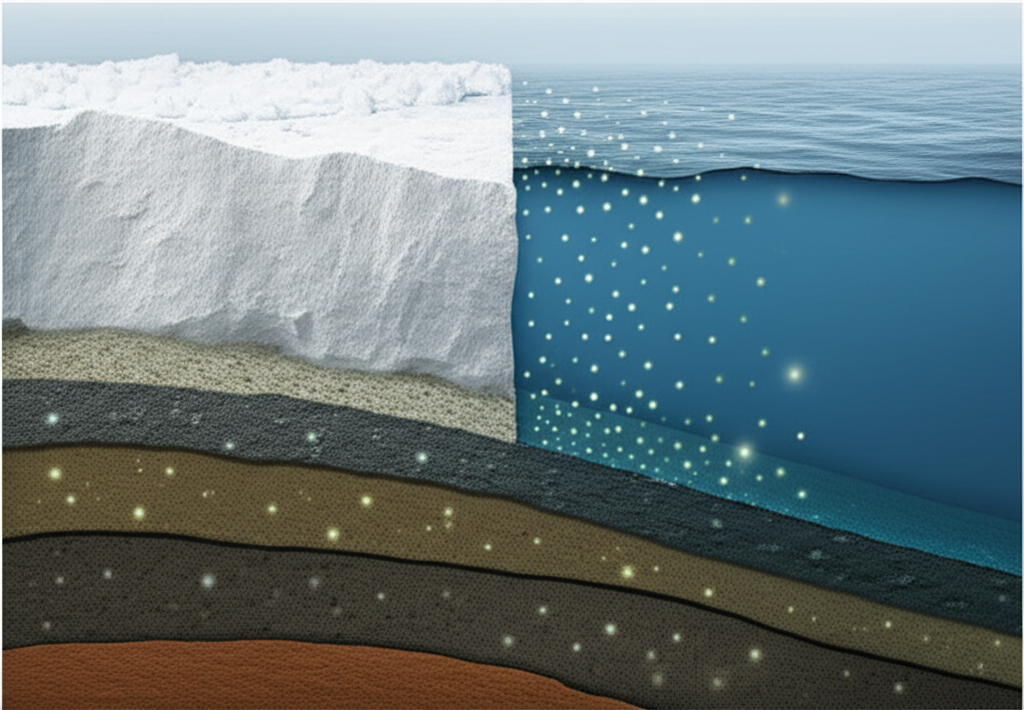
The methodology relies on the constant, steady rain of microscopic space dust that falls onto Earth. According to reports from the Smithsonian Magazine and Phys.org, this dust contains helium-3, a rare isotope that is abundant in the cosmos but scarce on Earth. Because this dust falls at a consistent rate, it acts as a "standard clock."
However, in the Arctic, sea ice acts as a barrier. When the ocean is frozen, the dust lands on the ice and is eventually drifted away or melted elsewhere. When the water is open, the dust sinks directly to the bottom. By analyzing sediment cores from the Arctic seafloor and measuring the ratio of extraterrestrial helium-3 to terrestrial thorium-230, the research team was able to determine exactly when the ocean was covered by ice and when it was open water.
"We present continuous 30,000-year reconstructions of sea-ice coverage from the Arctic Ocean based on measurements of two isotopes, thorium-230 and extraterrestrial helium-3, whose burial ratio changes with sea-ice coverage." - ResearchGate Abstract
Filling the Data Void
This innovation addresses a significant blind spot in climate science. Reliable satellite imaging of sea ice only dates back to 1979-a mere blink in geological time. As noted by The New York Times, this lack of long-term data has made it difficult to distinguish between natural climate variability and human-induced changes. The 30,000-year record allows scientists to calibrate their models against periods of natural warming and cooling, such as the Last Glacial Maximum.
Discover Magazine reports that the sediment cores revealed a clear pattern: "year-round ice corresponded with reduced amounts of cosmic dust." This simple correlation has turned the seafloor into a detailed climate archive, unlocking data that was previously thought inaccessible.
Atmosphere vs. Ocean: A Crucial Distinction
One of the most significant findings of the study, highlighted by EurekAlert!, is the driver of ice loss. The data suggests that over the last 30,000 years, Arctic ice volume was dictated primarily by atmospheric temperatures rather than changes in ocean currents or water temperature. This has immediate relevance for today's climate crisis, where greenhouse gases are rapidly heating the atmosphere.
If atmospheric warming is the primary lever for sea ice retreat, then current trajectories of carbon emissions may accelerate the transition to seasonally ice-free summers faster than models prioritizing ocean circulation might suggest. This underscores the urgency of emissions mitigation strategies focused on atmospheric composition.
Geopolitical and Economic Implications
The ability to accurately predict ice loss has stakes far beyond academia. As Science.org notes, Arctic sea-ice loss affects biological productivity and sustenance in coastal communities. Furthermore, the opening of Arctic shipping routes is a major geopolitical flashpoint. Nations bordering the Arctic are already vying for control over new transit lanes and resource-rich seabeds. A more accurate predictive model derived from this cosmic dust data will likely inform national security strategies and economic planning for decades to come.
Looking Ahead
The methodology pioneered by the University of Washington team is expected to be applied to other regions, potentially revolutionizing paleoclimatology. Experts indicate that this "cosmic yardstick" effectively distinguishes extraterrestrial particles from terrestrial sediments in ways previously impossible. As this data is integrated into global climate models, we can expect a refinement in the forecasts that guide international climate policy.
"It's like a big equation with many unknowns," researchers told The Cool Down, referring to the complexities of the climate system. With the addition of 30,000 years of hard data, one of those major unknowns has finally been solved.