Deep beneath the Apennine Mountains in Italy, within the Gran Sasso National Laboratory, a decades-long quest to understand the heart of our Sun has reached its conclusion. The Borexino collaboration, a group of nearly 100 scientists, has published final results confirming the detection of solar neutrinos produced by the Carbon-Nitrogen-Oxygen (CNO) fusion cycle. This discovery, detailed in recent publications including Physical Review D in June 2024, marks the first direct experimental evidence of this specific stellar burning mechanism, validating theories that have underpinned astrophysics for nearly a century.
While the Sun is powered primarily by the proton-proton (pp) chain, the CNO cycle is hypothesized to be the dominant energy source for massive stars throughout the universe. By isolating these elusive "ghost particles" from the background radiation of Earth, researchers have provided a direct probe into the solar core, offering unprecedented insights into the life cycles of stars and the composition of our own solar system.
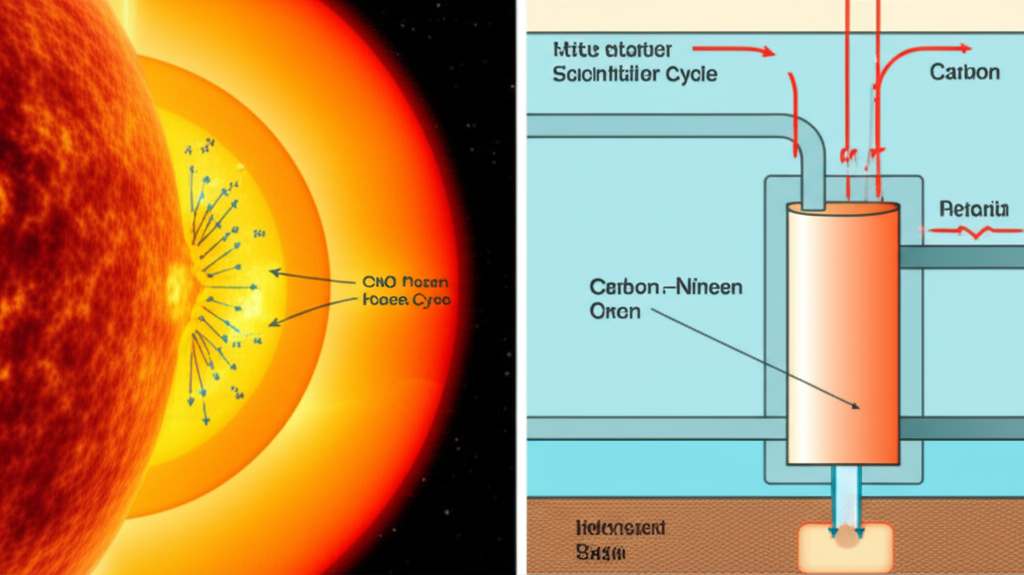
Unraveling the CNO Signal
The detection of CNO neutrinos is an achievement of extreme precision. According to reports from the Borexino collaboration, the main experimental challenge was identifying an excess signal of only a few counts per day per 100 tonnes of target material. These signals had to be distinguished from background noise, specifically the decay of Bismuth-210, which mimics the neutrino signature.
The timeline of this discovery highlights rapid progress in neutrino spectroscopy:
- November 2020: The collaboration published initial evidence in Nature, reporting the first experimental indication of neutrinos produced in the CNO fusion cycle.
- May 2022: An updated analysis presented in arXiv showed an improved measurement rate of approximately 6.7 counts per day per 100 tonnes.
- June 2024: Final results published in Physical Review D solidified the findings, demonstrating the detector's ability to efficiently distinguish between radiation types and confirming the CNO flux with high statistical significance.
"Neutrinos emitted in the core of the Sun are the only direct probe for the investigation of such processes." - Moscow University Physics Bulletin
Technological Triumph in the Dark
The success of the Borexino experiment rests on its unprecedented radiopurity. The detector, a large vat of liquid scintillator, searches for flashes of light produced when neutrinos knock into electrons. Because neutrinos interact so weakly with matter, the detector must be shielded from all other forms of radiation.
Experts indicate that the Borexino detector was specifically developed to detect these extremely rare interactions. The 2024 final results underscore the efficacy of liquid scintillator technology in performing complete spectroscopy of solar neutrinos. This capability has allowed physicists to unravel the two fundamental processes fueling stars: the pp-chain, which Borexino previously mapped, and now the CNO cycle.
Implications for Astrophysics and Beyond
The confirmation of the CNO cycle has broad implications for our understanding of the universe. While the CNO cycle accounts for a small fraction of the Sun's energy (around 1%), it is the dominant energy source for heavier, hotter stars. By validating the Standard Solar Model through these measurements, scientists can now apply these models with greater confidence to distant stars that are impossible to study directly.
Furthermore, these measurements help resolve the "solar metallicity problem"-a discrepancy regarding the abundance of elements heavier than helium in the Sun. The precise flux of CNO neutrinos is directly related to the density of carbon, nitrogen, and oxygen in the solar core, providing a new method to measure the Sun's chemical composition.
The Future of Neutrino Research
With Borexino's mission now complete, the focus shifts to the next generation of detectors. Reports from Physical Review D suggest that future experiments involving liquid xenon detectors could further explore solar neutrino capture via charged-current scattering. These next-gen facilities aim to improve sensitivity and reduce uncertainties even further.
As the global scientific community digests the final data from Gran Sasso, the legacy of Borexino is clear: it has illuminated the darkest corners of particle physics, proving that even the most ghostly particles can reveal the solid mechanics of the stars.