GENEVA/BOULDER - The massive optical tables that once defined high-precision laser physics are rapidly vanishing into the microscopic architecture of silicon chips. In a series of breakthrough developments spanning late 2024 to late 2025, scientists across global institutions have successfully integrated complex laser frequency control systems onto Photonic Integrated Circuits (PICs). These advancements, detailed in recent publications including Nature Communications and Nature Photonics, signal a paradigm shift for industries ranging from quantum computing to autonomous transportation.
The race to miniaturize these systems has been driven by the need for stable, "frequency-agile" light sources that can operate outside pristine laboratory environments. According to a March 2025 report in Nature Communications, researchers have now developed a PIC chip utilizing a "sine-cosine encoder principle" for real-time optical frequency variation measurement. This innovation addresses a critical bottleneck: traditional measurement devices were simply too large, slow, and costly for widespread deployment in next-generation technologies.
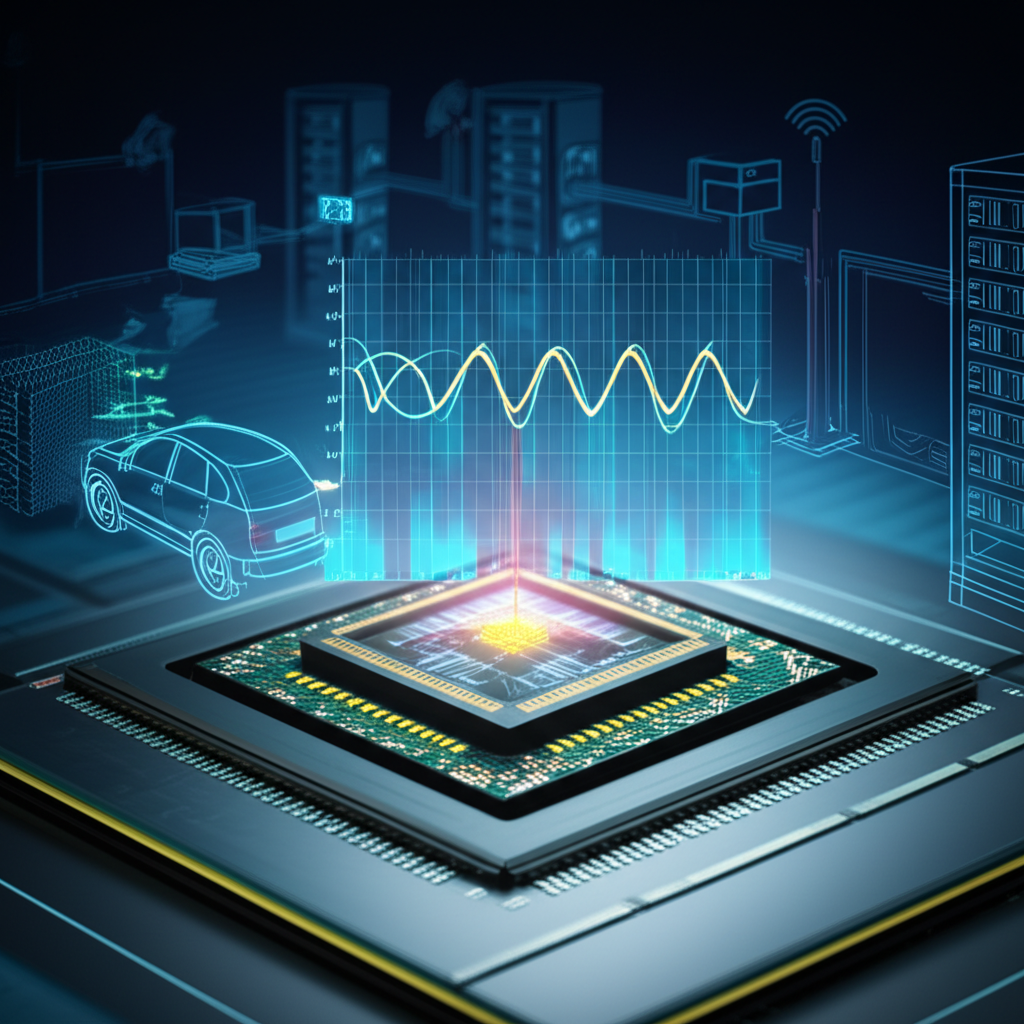
Timeline of Innovation: The 2025 Surge
The trajectory of chip-scale photonics has accelerated sharply over the last 18 months. Key milestones include:
- December 2024: Researchers demonstrate "frequency agile" lasers using monolithic integration of piezoelectric actuators on ultra-low loss silicon nitride circuits, as reported in APL Photonics. This allowed for precise tuning previously impossible on such a small scale.
- March 31, 2025: The debut of the on-chip sine-cosine encoder enables high-speed, high-resolution real-time detection of frequency changes, solving the "readout" problem for compact systems.
- April 9, 2025: A preprint released via arXiv details feedback-tolerant quantum dot lasers integrated onto 300mm silicon photonics wafers, proving that these devices can be manufactured at industrial scale.
- June 6, 2025: A landmark study in Nature Photonics demonstrates self-injection locking of an on-chip laser to a millimeter-scale vacuum-gap Fabry-Pérot cavity. This achieved frequency stability comparable to bulky reference cavities used in atomic clocks.
- September 23, 2025: The National Institute of Standards and Technology (NIST) presents findings on the heterogeneous integration of single-frequency lasers, further cementing the role of these devices in metrology standards.
Why "Lasers on a Chip" Matter
To understand the significance of these developments, one must look at the limitations of current technology. High-performance lasers used in sensing and communication typically require "external cavities"-physical chambers that stabilize the light-and bulky isolators to prevent feedback. These components make systems fragile and expensive.
The new generation of Photonic Integrated Circuits (PICs) changes the calculus. By utilizing materials like silicon nitride (Si3N4) and integrating piezoelectric MEMS (Micro-Electro-Mechanical Systems), engineers can now build lasers that are not only microscopic but also robust against vibrations and temperature shifts. As noted in Wiley Analytical Science, these fully packaged hybrid integrated systems now combine "wide wavelength tunability with chip-scale photonic integration," effectively putting a physics lab onto a sliver of silicon.
Expert Perspectives
"The realisation of on-chip light sources paves the way towards the full integration of Si-based photonic integrated circuits," note researchers in Light: Science & Applications.
Industry leaders are also weighing in on the commercial viability. SCINTIL Photonics has introduced single-chip dense multi-wavelength laser sources specifically designed to revolutionize AI scale-up photonic interconnects. Meanwhile, scientists led by Dr. Yang at EPFL have developed waveguide lasers that approach the performance of fiber-based systems, a critical threshold for commercial adoption.
Implications for Tech, Business, and Society
The AI Infrastructure Boom: As Artificial Intelligence models grow in size, data centers are hitting a "bandwidth wall." Electrical copper wires cannot move data fast enough between chips. The solution lies in optical interconnects-using light instead of electricity. The new multi-wavelength laser sources allow for massive data throughput directly on the processor package, a market SCINTIL and others are aggressively targeting.
Autonomous Systems and LiDAR: Frequency-Modulated Continuous-Wave (FMCW) LiDAR allows cars to "see" velocity as well as distance. However, it requires incredibly stable lasers. The integration of Vernier lasers with piezoelectric actuators, described in PMC and Laser Focus World, offers a pathway to cheap, mass-producible LiDAR sensors that are immune to interference, potentially accelerating the rollout of Level 4 autonomous vehicles.
Quantum Sensing and Navigation: Perhaps the most profound implication is in "GPS-free" navigation. High-precision atomic clocks and inertial sensors require stable laser combs. With the 2024 work from the Joint Quantum Institute showing chip-scale frequency combs, humanity moves closer to having quantum-grade navigation systems in portable devices, reducing reliance on satellite signals which can be jammed or spoofed.
Forward Outlook
The focus now shifts from the laboratory to the foundry. The compatibility of these new laser architectures with 300mm silicon wafers-the standard size for computer chip manufacturing-is crucial. As demonstrated in recent IEEE Spectrum reports, achieving 80% coupling efficiency on standard wafers suggests that mass production is imminent.
Looking ahead to late 2025 and 2026, experts anticipate the emergence of "heterogeneous integration" where lasers, modulators, and amplifiers are printed onto a single die. This will likely lead to a new class of "smart" optical sensors capable of real-time environmental monitoring and medical diagnostics, powered by the unseen, microscopic beams of chip-scale lasers.