BONN - In a significant advancement for environmental technology, researchers in Germany have successfully developed a filtration system modeled after the biological structure of fish gills, capable of removing over 99% of microplastic fibers from wastewater. The breakthrough, led by the University of Bonn in collaboration with the Fraunhofer Institute for Environmental, Safety, and Energy Technology UMSICHT, addresses one of the most persistent sources of global water pollution: the domestic washing machine.
The project, details of which were published this December in the journal Emerging Contaminants, moves beyond theoretical modeling into practical application. By mimicking the gill arch system of ram-feeding fish-such as anchovies-the team has created a self-cleaning mechanism that prevents the clogging issues plaguing current filtration methods. With a patent application already pending in Germany and EU-wide patenting underway, this innovation stands poised to reshape regulatory standards for household appliances and industrial wastewater management.
Biomimicry in Action: How It Works
The core challenge in filtering washing machine wastewater lies in the volume and nature of the debris. Standard filters often block water flow when saturated with lint and plastic particles, requiring frequent maintenance or causing pressure issues. The researchers at the University of Bonn looked to nature for a solution, specifically focusing on filter-feeding fish that manage to trap food particles while allowing water to pass through their gills effortlessly.
According to project data, the scientists scanned the gill arches and rakes of five different fish species to create detailed 3D models. They observed that in these biological systems, particles do not hit the filter head-on. Instead, the geometry of the gills creates a fluid dynamic where particles roll along the structure toward the gullet, while water exits through the gill slits. This "cross-flow" filtration prevents the mesh from becoming obstructed.
"We were able to show that the filtration principle could also work in a technical context," researchers stated in a release from the University of Bonn. "The aim is now to use and adapt this type of filtration technology to develop a new filter for reducing microplastic emissions."
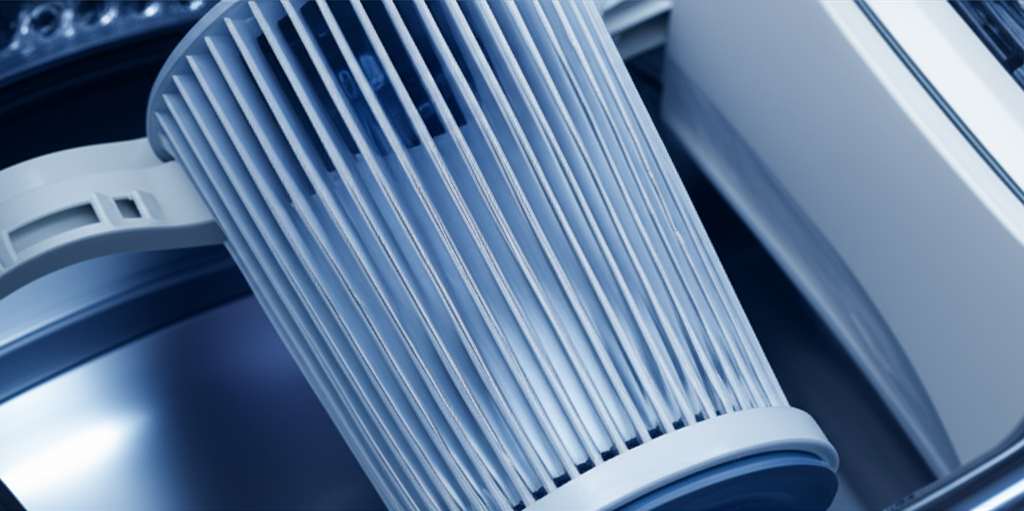
Translating this into a mechanical device, the team used 3D printers to produce simplified prototypes with optimized geometries. Testing confirmed that these artificial "gills" could deflect synthetic fibers into a collection chamber while maintaining water flow, achieving a removal efficiency of over 99%.
Context: The Microplastic Crisis
The urgency of this development is underscored by the growing recognition of microplastics as a pervasive environmental hazard. Synthetic textiles, such as polyester and nylon, shed millions of tiny fibers during every wash cycle. Because these particles are too small for standard municipal treatment plants to catch effectively, they flow directly into rivers and oceans, entering the food chain and eventually the human body.
Reports from Techxplore and SciTechDaily highlight that washing machines are a primary vector for this pollution. While some countries, such as France, have moved to mandate filters on new washing machines, the technology available has often been criticized for inefficiency or consumer inconvenience. The Bonn solution offers a "passive" system that requires less user intervention, potentially removing a major barrier to widespread adoption.
Implications for Industry and Policy
Business and Manufacturing
The commercial implications of this technology are substantial. With the European Union tightening regulations on microplastic emissions, appliance manufacturers are under pressure to innovate. The collaboration with the Fraunhofer Institute specifically aims to bridge the gap between academic research and industrial production. Experts indicate that the researchers hope manufacturers will integrate this technology directly into future generations of washing machines, rather than relying solely on aftermarket add-ons.
Environmental Health
Capturing 99% of fibers at the source would drastically reduce the load on sewage treatment plants. According to Noticias Ambientales, widespread implementation could significantly improve the performance of urban sanitation systems. Furthermore, reducing the volume of microplastics entering waterways addresses concerns regarding animal health and the bioaccumulation of toxins in the seafood supply.
Expert Perspectives and Future Outlook
The project has received significant backing, including an ERC Proof of Concept Grant, which facilitates the transition from research to marketable product. The development team, including researcher Kristina Schreiber, focused on a bio-inspired design that employs "semi-cross-flow filtration with a conical filter element geometry," ensuring longevity and efficiency.
Looking ahead, the path involves finalizing the EU-wide patent and securing partnerships with major home appliance brands. If successful, this technology could become a standard component in laundry appliances within the next decade. Moreover, the principles validated here have potential applications beyond laundry, including industrial textile production and larger-scale wastewater treatment facilities, proving that sometimes the best engineering solutions have already been invented by nature.