Let's be direct. Most of the 'AI for leaders' advice I read is theoretical nonsense. It's filled with buzzwords that sound impressive in a boardroom but offer zero guidance on what to do on Monday morning. After 25 years building technology companies from the ground up here in India and watching global trends, I can tell you that the era of simply talking about AI is over. The year 2025 will be defined by one thing: operationalization. It will separate the leaders who build enduring, intelligent organizations from those who are left managing legacy systems and confused teams.
The conversation is no longer about if you should use AI, but how you lead with it. It requires a fundamental rewiring of our leadership instincts, moving from top-down directives to creating frameworks where humans and algorithms can thrive together. This is not a technology challenge; it is a leadership revolution. The generative AI wave of the last few years was just the warm-up act. Now, the hard work begins: embedding intelligence into the very fabric of your organization.
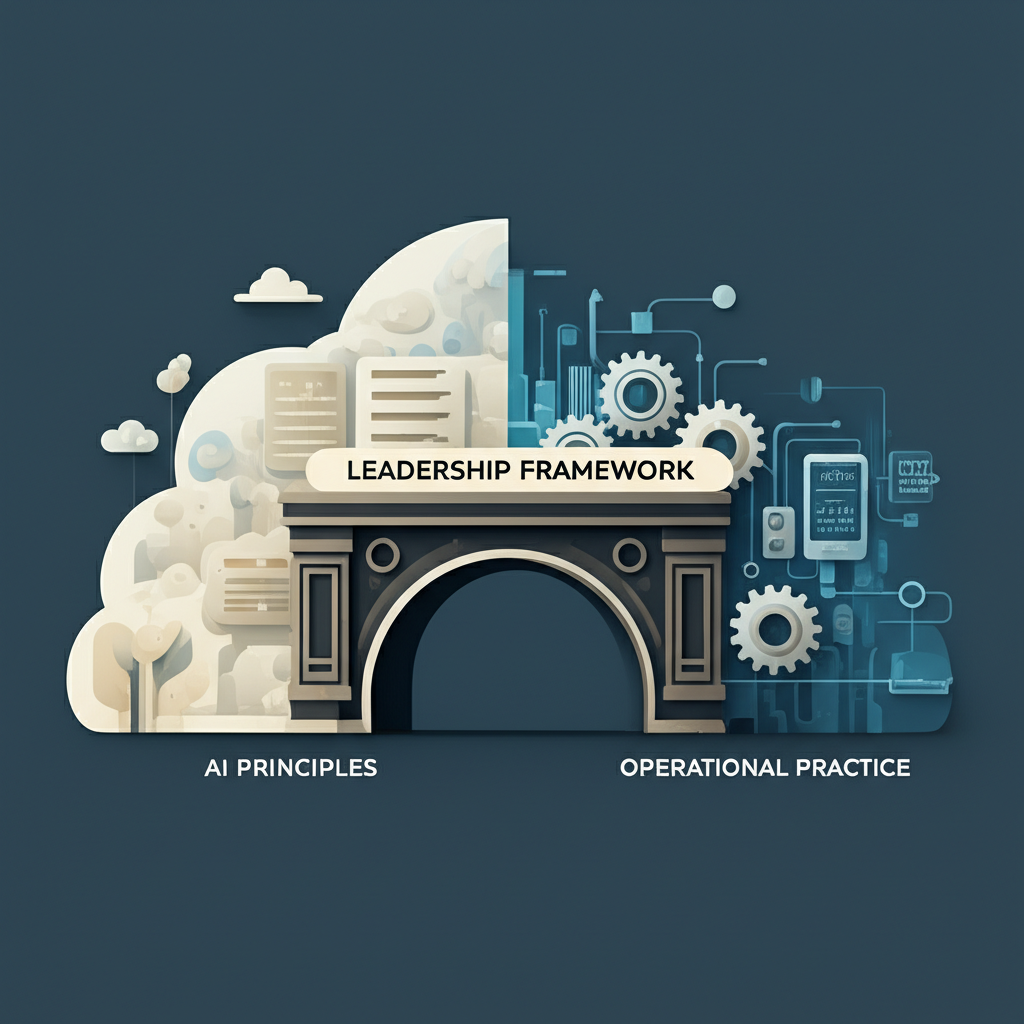
For executives and emerging leaders who want a practical blueprint, I've distilled the noise into four critical trends that you must master. These aren't just concepts; they are the pillars of the modern, agile, and responsible organization. Forget the hype and focus on the 'how'.
Pillar 1: From Boardroom Pledges to Code-Operationalizing Ethical AI Governance
Every company now has an 'AI Ethics' slide in their deck. It's become corporate theatre. But principles on a slide do not prevent a biased algorithm from denying someone a loan or a job. True governance moves ethics from a PR statement to an engineering requirement. As leaders, our job is to build the guardrails that make doing the right thing the easiest path for our teams.
I remember a project back in the early 2000s, long before we called it 'AI'. We were building a credit scoring model for a rural lender here in Gujarat. Our initial data was heavily skewed towards urban borrowers, and the model was disastrously rejecting perfectly creditworthy farmers. We had to spend months on the ground, manually collecting new data and recalibrating our assumptions. It taught me a lesson that is more critical today than ever: Your technology is only as unbiased as the data you feed it and the people who build it. That painful, expensive lesson from twenty years ago is the foundation of every ethical AI governance framework I advocate for today.
How to Move from Principle to Practice:
- Establish a Cross-Functional AI Ethics Board: This is non-negotiable. It cannot be just engineers. You need representatives from legal, HR, product, and customer-facing roles. This group's mandate is not to slow down innovation, but to stress-test it. They should review high-stakes AI projects before deployment, asking the hard questions about data sourcing, potential biases, and transparency.
- Implement 'Bias Bounties': Just as we pay security researchers to find vulnerabilities in our code, we must incentivize our teams and even the public to identify biases in our algorithms. This creates a culture of proactive accountability, making fairness a shared responsibility.
- Mandate 'Model Cards' and Transparency Docs: For every significant AI model deployed, require your teams to produce a simple, one-page document. It should explain what the model does, what data it was trained on, its known limitations, and its intended use case. This fosters transparency and prevents models from being used for purposes they weren't designed for.
Pillar 2: The End of Gut Feel? Augmenting Intuition with Decision Intelligence
For decades, leadership has been a blend of experience, data, and 'gut feel'. AI doesn't eliminate intuition, it supercharges it. The shift is from Business Intelligence (BI), which tells you what happened, to Decision Intelligence (DI), which models what could happen and recommends what you should do. While BI gives you a dashboard to look at the past, DI gives you a simulator to explore the future.
This is about transforming data from a passive report into an active strategic partner. Leaders who master this will consistently make faster, smarter, and more creative decisions than their peers. Recent industry analysis shows a clear divide between companies that use AI for reporting and those that use it for strategic foresight.
| Leadership Function | Traditional Method (Baseline) | AI-Augmented Method (Projected 2025 Impact) |
|---|
| Strategic Forecasting | Quarterly manual analysis of past performance data. | Real-time simulation of market scenarios, identifying black swan events. |
| Talent Development | Standardized annual training programs. | Personalized coaching based on individual performance data. |
| Operational Efficiency | Weekly dashboard reviews, reactive problem-solving. | Proactive identification of bottlenecks and prescriptive recommendations. |
Pillar 3: Human-AI Collaboration: Designing Your Augmented Workforce
The fear of replacement is pervasive, but it is born from a failure of leadership imagination. The most successful organizations in 2025 will not be the ones with the most AI, but the ones with the most effective human-AI collaboration. Our role as leaders is to be the architects of this new symbiosis, redesigning workflows where AI handles the computational heavy lifting, and humans focus on strategy, creativity, and empathy.
The goal of a leader is not to replace people with AI, but to create an environment where every person is augmented by AI. Success is measured not by headcount reduction, but by capability amplification.
To do this, we must stop thinking of AI as just a tool and start thinking of it as a new kind of team member. Here are the first steps to take:
- Map Your Workflows for Augmentation: Instead of asking 'Whose job can AI do?', ask 'What are the points of friction, repetition, and cognitive overload in our key processes?'. Target these areas first. For example, augment your sales team with an AI that drafts follow-up emails and analyzes call sentiment, freeing them to build relationships.
- Invest in 'Human-in-the-Loop' Training: Your teams need new skills. They need to learn how to ask AI the right questions, how to interpret its outputs critically, and when to override its recommendations. This is the most crucial skill set of the next decade.
- Redefine KPIs to Reward Collaboration: Shift performance metrics away from purely individual output. Create incentives for teams that effectively use AI to achieve a better collective outcome. Did the marketing team use a generative AI to test 50 ad variations instead of 5? Reward the experiment and the learning, not just the winning ad.
Pillar 4: The Rise of the AI Coach: Personalizing Leadership Development
The final pillar is perhaps the most personal. For our organizations to adapt, we as leaders must adapt first. The future of leadership development is personalized, data-driven, and scalable, and it will be powered by AI. AI-powered coaching platforms are emerging that can provide real-time feedback on your communication style in meetings, analyze the sentiment of your team's messages to flag potential burnout, and create simulations to practice difficult conversations.
This isn't about replacing human mentors. It's about providing every emerging leader with a tireless, objective sparring partner that helps them hone their skills. Imagine a junior manager getting personalized tips after every team call on how to be more inclusive in their language or how to frame feedback more constructively. This is how we build the next generation of leaders at scale.
Your First Step:
Start small. Experiment with a tool that analyzes your own communication. Use an AI meeting assistant to summarize your calls and track action items. The goal is to develop a personal comfort level with AI as a collaborator in your own leadership journey. You cannot lead your organization into this new territory if you haven't walked the path yourself.
Conclusion: The Leadership Mandate for 2025
Leading in the age of AI is not about becoming a data scientist. It is about having the courage to build a new type of organization: one that is transparent in its governance, intelligent in its decisions, collaborative in its structure, and committed to continuous learning. These four pillars-ethical governance, decision intelligence, human-AI collaboration, and AI-powered coaching-are not independent trends. They are an interconnected framework for building a resilient, future-ready enterprise.
The technology is ready. The question is, are we? Your legacy as a leader will be determined by the choices you make in the next 12-18 months. The future is not something we enter; it is something we create. Start building your AI-native leadership framework today.