The Autonomous Enterprise: Navigating the Rise of Agentic AI
Over my 20-plus years leading marketing operations from Los Angeles, I've witnessed technological waves that promised to redefine business. We went from manual processes to digital, from static websites to dynamic platforms, and from basic automation to AI-powered suggestions. Each step was significant. But what we're seeing now isn't just another wave-it's a seismic shift. We're moving beyond AI that merely suggests or converses. We are entering the era of Agentic AI, where systems don't just analyze; they act.
For too long, the conversation around enterprise AI has been dominated by two concepts: the conversational chatbot handling customer queries and the helpful copilot offering suggestions to a human user. While valuable, these are essentially advanced assistants. They operate within a human-led workflow. Agentic AI shatters this paradigm. We're talking about autonomous systems capable of understanding a high-level goal, reasoning through the necessary steps, creating a multi-stage plan, and then executing that plan by integrating with your core software, APIs, and databases. This is the difference between an analyst who prepares a report on market trends and a director who reads the report, devises a strategy, and allocates a budget to execute it. One informs, the other does.
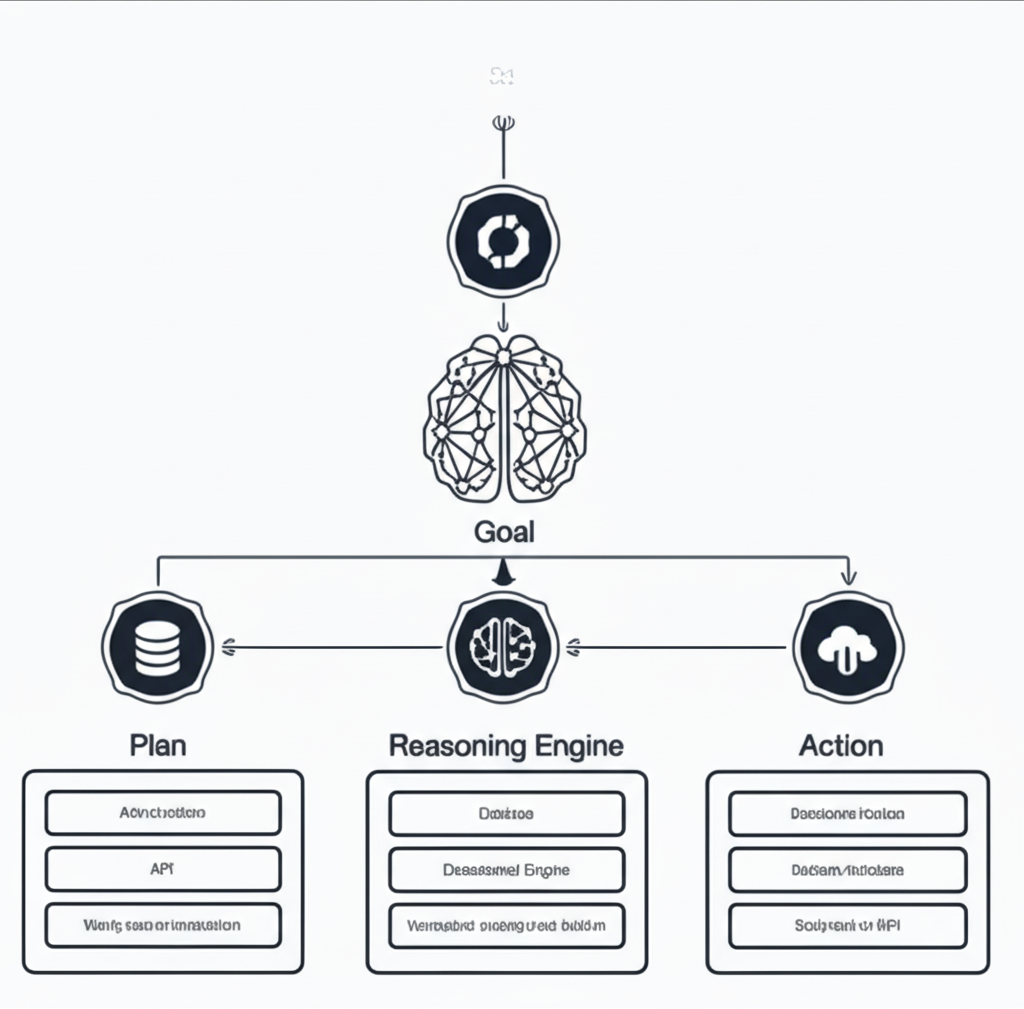
This leap from suggestion to autonomous execution is where the true transformative potential lies for the modern enterprise. It's about creating a digital workforce that can operate 24/7, handling complex, multi-system processes with speed and precision far beyond human capability. This isn't science fiction; it's the new operational reality that leaders need to understand and prepare for.
From Conversation to Execution: How Agentic AI Redefines Work
To truly grasp the power of agentic AI, we must move past the familiar interface of a chat window. An AI agent is a persistent, goal-oriented system that operates on a continuous loop of reasoning and action. It's designed not just to answer a single query but to achieve a complex outcome.
The Core Components of an AI Agent
At its heart, an agent functions through a sophisticated cycle. It starts with a Goal (e.g., "Resolve network outage ticket #5829"). It then uses its Reasoning Engine to break this goal down into a logical sequence of tasks. This forms a Plan (e.g., 1. Access network monitoring tool via API. 2. Analyze logs to identify the point of failure. 3. Access router configuration API. 4. Reroute traffic. 5. Create a ticket in the IT service management tool. 6. Notify stakeholders via email API). Finally, it takes Action, executing these steps by interacting with various software and tools. It continuously assesses the results of its actions, adapting its plan as needed until the goal is achieved. This ability to self-correct and navigate unforeseen obstacles is what makes it truly autonomous.
Agentic AI in Action: Real-World Enterprise Transformation
The theory is powerful, but the practical applications are what truly excite me. We're already seeing clients explore and implement agentic systems that are fundamentally changing how their core business functions operate. Let's look at a few concrete examples.
Automated Incident Response in Telecom
A major telecom provider can deploy an AI agent to monitor its vast network infrastructure. When a performance degradation alarm is triggered, the agent doesn't just send an alert. It autonomously initiates a diagnostic protocol, queries logs from multiple systems, identifies the root cause-perhaps a faulty switch-and executes a pre-approved plan to reroute data traffic to a backup system, all within seconds. It then generates a detailed incident report and archives it, minimizing downtime and freeing up highly skilled network engineers to focus on strategic improvements rather than firefighting.
Self-Optimizing Supply Chains in Logistics
Consider a global logistics company. An AI agent can be tasked with ensuring on-time delivery for high-value shipments. This agent continuously monitors dozens of variables: weather patterns, port congestion data from IoT sensors, customs processing times, and even social media sentiment for news of potential disruptions. If it predicts a delay at the Port of Singapore, it can autonomously reason that rerouting a container through a different port, though initially more expensive, will prevent a costly multi-day delay. It can then execute the change by interacting with the booking system, updating the ERP, and notifying all relevant parties. This proactive, self-optimizing capability is something a human-led team, constrained by time and data processing limits, could never achieve at scale.
Intelligent Back-Office Automation in Retail
In my career, I've seen firsthand how much time is lost in coordinating complex, multi-vendor marketing campaigns. I remember one global product launch where my team spent weeks just synchronizing deliverables between a dozen different agencies, localization vendors, and media buyers across eight countries. It was a logistical nightmare of spreadsheets and time zones. An AI agent today could manage that entire process. It could be given the goal: "Execute the 'Project Titan' launch campaign by Q4." The agent would then access the project plan, interact with vendor APIs to assign tasks, monitor deadlines, automatically process invoices upon deliverable approval, and provide real-time budget tracking to stakeholders. The human team would be elevated from frantic coordinators to strategic overseers.
The New Frontier of Risk: Governance in the Age of Autonomy
With great power comes a new paradigm of risk. Handing over mission-critical tasks to autonomous agents requires a robust framework for governance, safety, and control. This is no longer just about data privacy; it's about operational integrity.
The true challenge of enterprise AI is not in building intelligent systems, but in building trustworthy ones. As we grant agents more autonomy, our investment in governance, oversight, and safety protocols must grow exponentially. Trust is the ultimate currency.
Organizations must grapple with the "black box" problem-understanding why an agent made a particular decision. We need to build systems with clear audit trails and implement "human-in-the-loop" checkpoints for high-stakes decisions. Furthermore, AI safety becomes paramount. How do you prevent an agent from misinterpreting a goal and causing operational or financial damage? The guardrails we build around these systems are just as important as the systems themselves.
To put the evolution into perspective, consider how these technologies compare across key business dimensions:
| Dimension | Traditional Automation (RPA) | AI Copilots | Agentic AI |
|---|
| Autonomy Level | Low (Follows rigid scripts) | Medium (Suggests, assists human) | High (Plans and executes autonomously) |
| Task Complexity | Simple, repetitive tasks | Complex analysis and content creation | Multi-step, cross-system workflows |
| Adaptability | Brittle; breaks with process changes | Adapts to conversational context | Dynamically adapts plan to new data |
| Potential ROI (1-2 Years) | Moderate (Efficiency gains) | High (Productivity boost) | Very High (Process transformation) |
| Implementation Risk | Low | Moderate | High (Requires strong governance) |
Your First Step into Agentic AI: A Practical Framework for Adoption
The prospect of deploying fully autonomous agents can be daunting. The key is not to attempt an enterprise-wide rollout overnight. Instead, I advise our clients to adopt a measured, iterative approach focused on building confidence and demonstrating value. Here is a practical framework to get started:
- Identify a High-Impact, Low-Risk Use Case. Don't start with a core, customer-facing process. Look for an internal workflow that is highly manual, rule-based, and time-consuming. Think internal IT support ticket routing, vendor invoice processing, or marketing campaign performance reporting.
- Define Clear Guardrails and Success Metrics. What is the agent allowed to do? What systems can it access? Crucially, what does success look like? Define clear, measurable KPIs, such as "reduce report generation time by 90%" or "achieve 95% accuracy in ticket categorization."
- Build a Single-Function Agent. Start with an agent designed to perform one specific, end-to-end function. This minimizes complexity and makes it easier to troubleshoot and validate performance. Ensure it has a "stop" button and clear human oversight.
- Monitor, Learn, and Iterate. Deploy the agent in a sandboxed or limited environment first. Closely monitor its actions and decisions. Use this phase to learn its behaviors, refine its logic, and improve its performance before a wider rollout.
- Demonstrate ROI and Build a Scaling Roadmap. Once your first agent has proven its value against the metrics you defined, you have a powerful internal case study. Use this success to secure buy-in for more complex projects and build a strategic roadmap for scaling agentic capabilities across the organization.
When planning your first project, focus on a few key prerequisites:
- API Accessibility: The agent will need well-documented APIs to interact with your existing software.
- Data Quality: The agent's reasoning is only as good as the data it can access. Ensure clean, structured data is available.
- Clear Human Oversight: Designate a clear owner and establish a process for reviewing the agent's actions, especially in the early stages.
- Defined Scope: Be ruthlessly specific about the agent's goal and the boundaries within which it can operate.
The Future is Autonomous
Agentic AI represents a fundamental shift in our relationship with technology-from using tools to collaborating with autonomous partners. It promises to unlock unprecedented levels of efficiency and innovation, allowing human talent to focus on strategy, creativity, and the complex challenges that still require our unique insight. The journey to an autonomous enterprise will be incremental, demanding careful planning, robust governance, and a commitment to responsible innovation. But for organizations willing to take the first step, the competitive advantage will be immense.
If you're ready to move beyond the prompt and explore how a custom, single-function AI agent could start delivering value for your business, my team and I are here to help you build that first proof-of-concept. Let's start the conversation.