In my 25 years navigating the dynamic currents of entrepreneurship, I've witnessed technological advancements that once felt like science fiction become everyday reality. From the early days of desktop computing to the rise of cloud infrastructure and advanced automation, the pace has been relentless. Yet, a fundamental challenge has always loomed large for Artificial Intelligence: bridging the chasm between theoretical data and the messy, unpredictable nuances of the real world. Traditional AI, brilliant as it is, often struggles with common-sense reasoning – that intuitive grasp of how things work in a physical space, something a toddler masters effortlessly.
This isn't just an academic hurdle; it's a practical limitation that has held back AI from truly solving complex, unstructured problems. We've had AI that can beat chess grandmasters and diagnose diseases, but ask it to navigate an unfamiliar room, pick up a dropped object, or understand the subtle physics of a stack of blocks, and it falters. But what if AI could learn by doing, by experiencing a world much like we do? This question has been at the heart of recent breakthroughs, and Google's latest initiatives, training AI in interactive 3D simulations, are precisely what's set to revolutionize how we perceive and apply intelligence.
The Dawn of Embodied AI: Learning Beyond Data Sheets
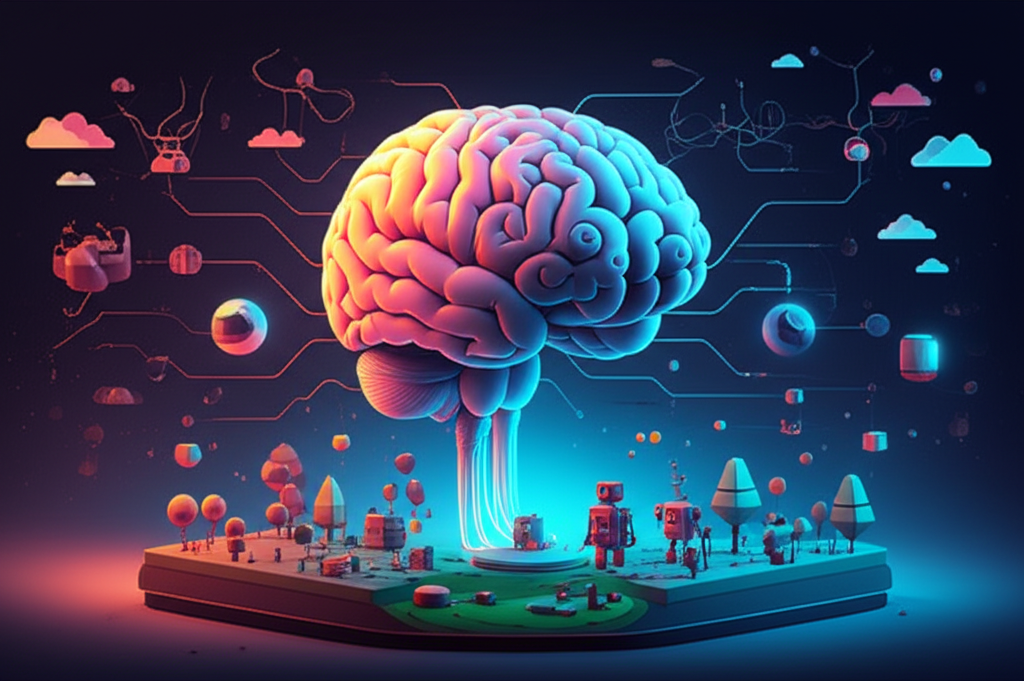
The concept of "embodied AI" is not entirely new, but Google's approach scales it to an unprecedented level. Imagine an AI not just processing vast datasets of text and images, but actually 'living' within a simulated 3D environment. This AI isn't just looking at pictures of objects; it's interacting with them. It pushes virtual blocks, observes gravity, navigates through obstacles, and learns the cause-and-effect relationships that govern our physical reality. This interactive learning is akin to how a child learns: through play, experimentation, and direct experience. It's about moving from abstract representation to concrete interaction, equipping the AI with a deeper, more robust understanding of its environment.
Why 3D Simulations are a Game-Changer
The power of 3D simulations lies in their ability to provide an infinite, safe, and controllable sandbox for AI to learn. In these virtual worlds, AI can perform millions of experiments in parallel, without the constraints or dangers of the physical world. It can learn about physics, spatial reasoning, object permanence, and interaction dynamics by experiencing them directly. This repetitive, embodied experience allows the AI to develop an intuition for how the world works, something that purely observational learning struggles to achieve. It’s not just recognizing a chair; it’s understanding that a chair can be sat on, pushed, or lifted, and that it has weight and occupies space. This interactive process is building the foundational common sense that has been the holy grail of AI research.
I recall an early challenge in my entrepreneurial journey, building a logistics system for a nascent e-commerce venture in India back in the late 90s. Our initial theoretical models, based purely on traffic data and road maps, were constantly derailed by real-world variables: sudden street vendors, unexpected potholes, a local festival blocking a route, or a monsoon downpour turning a street into a river. The system, for all its data processing power, lacked the common sense to adapt to these unprogrammed, emergent situations. We had to build in layers of human-driven, real-time feedback and local expertise to compensate. It took years of empirical learning and iterative adjustments to develop a truly robust system. This experience profoundly illustrates why theoretical data, however vast, often falls short without the 'embodied' understanding of environmental context – precisely what Google’s new AI is designed to overcome.
From Code to Common Sense: Bridging the Real-World Gap
The brilliance of this simulated training is that it's teaching AI to infer and predict based on real-world principles, not just statistical correlations. When an AI learns to pick up an object in a virtual environment, it’s not just memorizing the motion; it’s understanding the concept of grip, force, and balance. This translates into a more adaptable intelligence. When faced with a novel situation in the real world – say, a robot needing to grasp an object it’s never seen before – its embodied training allows it to apply common-sense reasoning derived from millions of similar interactions. This drastically reduces the need for extensive real-world data collection, a bottleneck for many AI applications, and accelerates deployment.
Impact on Complex Problem Solving
This leap forward in common-sense reasoning has profound implications for complex problem-solving. Consider autonomous robotics: instead of needing to program every possible scenario, robots trained in 3D simulations can develop an intuitive understanding of their environment, enabling them to navigate complex human-centric spaces, perform delicate manipulation tasks, and respond to unforeseen circumstances with greater agility. In manufacturing, these AIs could optimize supply chains by dynamically adapting to disruptions. In urban planning, they could simulate and predict the impact of new infrastructure with unparalleled accuracy, understanding how changes ripple through a complex system of traffic, people, and resources, from bustling cities in the United States to rapidly expanding urban centers in the Middle East.
During a pivotal period in my career, scaling a technology firm across continents – from Europe to Australia – I faced a leadership dilemma. Our highly efficient, process-driven teams were struggling to adapt to the nuanced cultural and regulatory landscapes of new markets. The theoretical 'best practices' we deployed, while logically sound, often clashed with local customs, social dynamics, or unwritten rules. It wasn't about more data; it was about understanding context, intuition, and unspoken cues – the 'common sense' of human interaction. We eventually cultivated local leadership and empowered teams to learn from their environment, developing adaptive strategies rather than rigid adherence to global templates. This experience profoundly illustrates that true intelligence, whether human or artificial, lies not just in processing information, but in understanding and skillfully navigating the implicit realities of its operating environment. This is exactly the kind of contextual awareness embodied AI promises.
Strategic Insight: The future of innovation isn’t just about building smarter machines; it’s about building machines that learn smarter. For founders and leaders, this means shifting focus from merely acquiring data to designing environments – real or simulated – where intelligence can organically develop common-sense reasoning, unlocking solutions to problems previously deemed intractable.
What This Means for Founders, Leaders, and Innovators
For founders, this is an invitation to dream bigger. Embodied AI opens up entirely new product categories and service models. Imagine AI-powered construction robots that understand structural integrity and material properties, or smart cities in the UK and India that can dynamically re-route traffic and manage resources based on real-time, nuanced environmental understanding. For leaders, it’s about recognizing that the competitive edge will increasingly come from leveraging AI that can operate autonomously and intelligently in the physical world. This requires a re-evaluation of current operational paradigms and a proactive investment in emerging AI capabilities.
Actionable Steps for Embracing Embodied AI
Educate Your Teams: Foster an understanding of embodied AI’s potential beyond traditional data analytics. Encourage learning about simulation technologies and real-world robotics.
Identify Use Cases: Analyze your business for areas where physical interaction, complex spatial reasoning, or common-sense understanding are current bottlenecks. Think about logistics, manufacturing, environmental monitoring, or even customer service robotics.
Pilot with Purpose: Start small. Invest in pilot projects using embodied AI tools or platforms (even simulated ones) to solve specific, well-defined problems. Learn from these experiments.
Foster Cross-Disciplinary Collaboration: Bring together your AI specialists with engineers, product designers, and operational experts. The best solutions will emerge from blending theoretical AI knowledge with practical, domain-specific wisdom.
Prioritize Ethical Development: As AI becomes more autonomous and interacts with the physical world, ethical considerations around safety, bias, and accountability become paramount. Integrate ethical frameworks from the outset.
My Vision: A Future of Integrated Intelligence
The journey of AI, much like my own entrepreneurial path, has always been about overcoming limitations and envisioning what’s next. Google’s work with embodied AI in 3D simulations marks a significant milestone, propelling us towards an era where AI isn’t just smart, but possesses a genuine understanding of the physical world. This isn’t just about efficiency; it’s about unlocking unprecedented levels of creativity and problem-solving. As leaders and innovators, our role is to guide this evolution responsibly, ensuring that these powerful new intelligences enhance human capabilities, elevate our societies, and help us build scalable, future-ready companies that thrive on innovation and a deeper understanding of reality. Let’s embrace this next frontier with curiosity, courage, and a commitment to positive impact.