In my role at IndiaNIC, I oversee the core infrastructure that powers our innovation-the hardware, the software, the very foundation upon which our global teams build the future. I've witnessed countless technological shifts, each met with a predictable wave of excitement and apprehension. Yet, nothing has stirred the pot quite like the recent explosion of generative AI. The dominant narrative is one of fear: that AI will devalue art, automate imagination, and ultimately replace the human creator.
From my vantage point, however, I see a different story unfolding. I argue that AI is not a creativity killer. It is a revealer. It is a powerful, uncompromising lens that separates true, intentional creativity from mere technical proficiency. It exposes our reliance on formula and, in doing so, elevates the very human skills that matter most: vision, emotion, and curation.
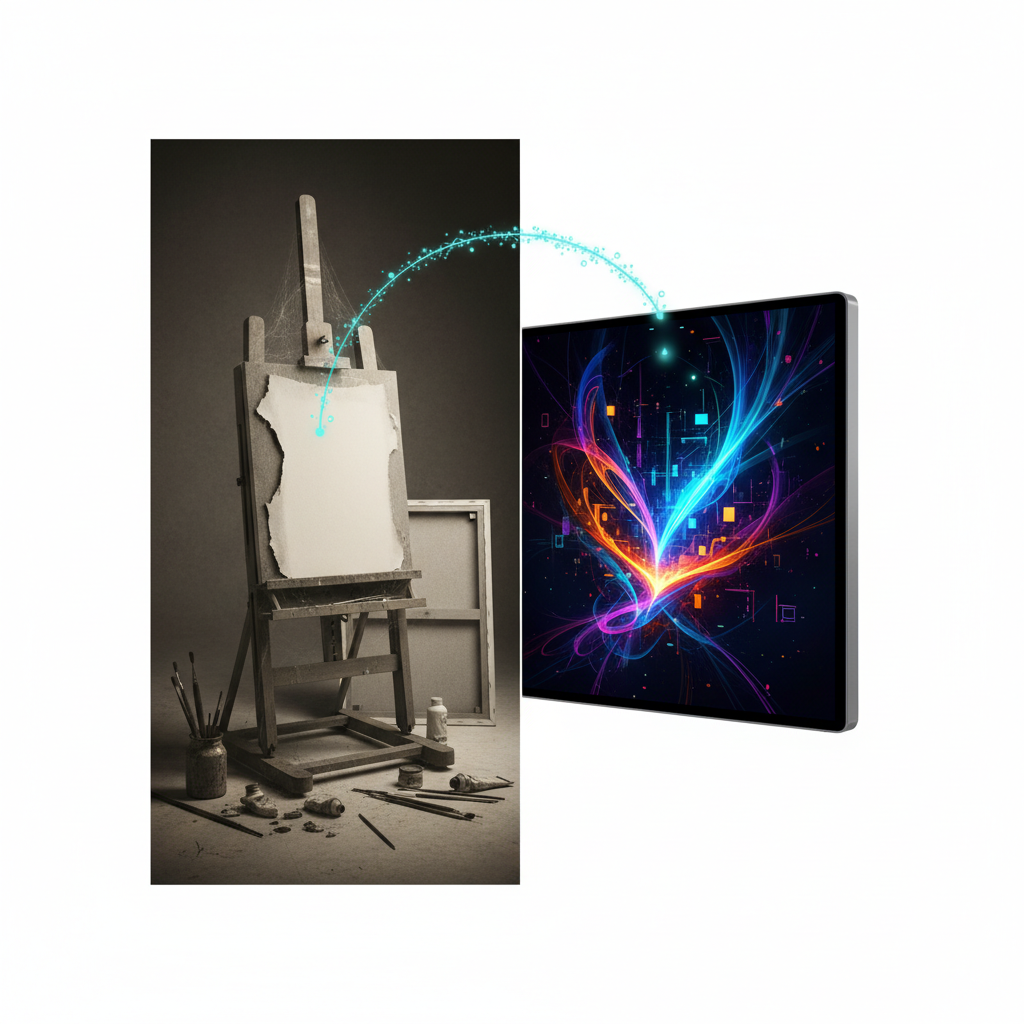
The anxiety is understandable. When a tool can generate a stunning image, a coherent piece of prose, or a complex piece of code in seconds, it's natural to question the value of the years an artist, writer, or developer spent honing their craft. But this perspective mistakes the craft for the art. It confuses the ability to execute a task with the vision required to conceive it in the first place.
Beyond the Assembly Line: Deconstructing the Myth of AI as a Creativity Killer
History provides a useful guide here. When photography emerged, painters feared their craft would become obsolete. Why spend weeks on a portrait when a camera could capture a likeness in a moment? Yet, painting didn't die; it was liberated. Freed from the burden of pure representation, artists explored impressionism, cubism, and abstraction. Photography became its own art form, while painting evolved to express what a camera could not: emotion, perspective, and inner worlds.
We are at a similar inflection point. Generative AI is automating the technical aspects of creation at an unprecedented scale. It can master the digital brushstrokes of a thousand different artists, replicate complex lighting, and adhere to the rules of perspective with flawless precision. But what it cannot do is supply the intent. It can generate a technically perfect image of a sad robot in the rain, but it cannot decide that this specific image is the perfect metaphor for technological loneliness that will resonate with a specific audience. That requires a human visionary.
Democratization of Production vs. Elevation of Vision
By democratizing the means of production, AI floods the market with content that is technically competent but often conceptually hollow. Anyone can now generate a beautiful, polished image or a well-structured paragraph. This doesn't devalue creativity; it makes genuine, original vision more valuable than ever. The signal must become stronger to cut through the noise. When everyone has a paintbrush, the person with a truly unique story to tell becomes the star. The focus shifts from how something was made to why it was made.
The Unmasking of Formula: When Technical Skill Is No Longer a Moat
Let's be honest: a significant portion of commercial creative work has long relied on established formulas, trends, and templates. AI is exceptionally good at identifying and replicating these patterns. If your creative process is simply to apply a popular filter, follow a proven story structure, or use a trendy color palette, then yes, AI is a direct competitor. It exposes work that is built on imitation rather than innovation.
I recall a pivotal moment a few months ago when we were setting up a new high-performance computing cluster for our design and marketing teams, specifically to handle advanced AI models. There was a palpable sense of unease among some of our most skilled designers. They had spent years mastering complex software, and here was a machine that could replicate their output in minutes. During a strategy meeting, our Creative Director addressed this head-on. He said, "This doesn't replace you. It challenges you. For years, our value was in our ability to master the tools. Now, anyone can make something that looks good. Our real job begins: to make something that feels right, that connects, that means something." That conversation shifted our entire perspective. We weren't just installing hardware; we were recalibrating our definition of creative value.
In the past, mastery was often defined by the technical skill of the hand. In the age of AI, mastery is defined by the clarity of the mind and the depth of the heart. The true innovator is not the one who can use the tool best, but the one who can guide the tool with the most compelling vision.
The New Creative Imperative: Thriving in an Age of AI Amplification
So, how do professionals thrive in this new landscape? The answer lies in doubling down on the irreplaceable human elements of creativity. AI is a powerful collaborator, but it needs a human partner to steer it. The most successful creators will be those who master the art of this partnership, focusing on skills that AI can augment but never originate.
These core human-centric skills are now at a premium:
- Conceptual Thinking: The ability to formulate a unique, compelling idea from scratch. This is the seed of all great work-the core message, the foundational concept, the "what if?" that AI cannot ask on its own.
- Emotional Resonance: Crafting work that connects with the nuanced, complex, and often irrational landscape of human experience. AI can simulate emotion, but it cannot feel it.
- Critical Curation: The flood of AI-generated options makes the ability to select, refine, and combine elements more critical than ever. It's the difference between a random collage and a masterpiece.
- Strategic Intent: Having a clear purpose and a distinct voice that guides every choice. This is about ensuring the final output is not just aesthetically pleasing but also strategically sound and true to a brand or an artistic identity.
Industry analysis reflects this dramatic shift in perceived value. Technical execution, while still necessary, is no longer the primary differentiator it once was.
| Creative Skill Category | Perceived Value (Pre-GenAI) | Perceived Value (Post-GenAI) |
|---|
| Technical Execution (e.g., Software Mastery) | High | Medium |
| Conceptual Ideation & Originality | High | Critical |
| Strategic Curation & Editing | Medium | Very High |
| Emotional Storytelling | High | Critical |
As the table illustrates, the value proposition is moving away from the hand and toward the head and heart. The trend-followers who rely on technical tricks will be exposed, while the true innovators who use AI to accelerate their unique vision will pull further ahead.
Conclusion: Your Vision, Amplified
Generative AI is not an endpoint for human creativity; it's a powerful catalyst for its evolution. It is a tool that, by its very nature, holds up a mirror to our own processes. It forces us to ask: Is my work built on a unique vision, or is it an echo of a popular style? Am I creating with intent, or am I simply following a well-worn path? The tool is not the artist. The prompt is not the poem.
At IndiaNIC, we are not just adopting these tools; we are embracing this new creative paradigm. We are investing in the infrastructure, yes, but more importantly, we are investing in the people who can wield that infrastructure with purpose and vision. For professionals everywhere, the path forward is clear. Stop fearing AI as a replacement. Instead, see it for what it is: the great revealer. Use it to strip away the mundane, to accelerate your workflow, and to amplify your unique, irreplaceable human voice.
The future doesn't belong to the AI, nor does it belong to the Luddite. It belongs to the visionary who knows how to collaborate with the machine to create something truly new.